

TRANSFERRED – the first GN in Season Two of our reboot of Roy Of The Rovers was released recently, pretty much at the same time as a bunch of us got together in Rebellion’s new offices to plan out Roy’s Season Three.
This is pretty much a ‘Writers Room’ method of working, inasmuch as it’s a bunch of people locked away for a day to break the story, with some of us bringing in a few ideas we’ve had prior to getting together and some things just getting made up on the spot. Then we knock them around, things get riffed on, stories take a direction that you don’t expect. It’s collaborative, and if you’re lucky it all has no ego and a good, positive energy and you come away with a series plot that has bits of everyone in there. It’s very teamwork – which should work perfectly for Roy Of The Rovers. We break up the story into chapters of Novel – Graphic Novel – Novel etc. Work out the cliffhanger beats where each writer hands over to the other, then we go away and I write my script at home in the months to come, Tom Palmer (who writes the Roy novels) writes his ‘chapters’ of Roy’s story, and the collaboration continues via emails.

You can buy Transferred – and the other Roy comics and novels – here: https://royoftheroversofficial.com/shop/graphic-novels/RCA-R2004
In this case, the writers’ room dynamic is genuinely a very positive experience. Although that isn’t always the case. I very much recommend ‘Difficult Men‘ by Brett Martin, about TV showrunners such as David Chase (Sopranos) and Matthew Weiner (Mad Men). There’s a fair few tales of people leaving writers’ rooms in tears there. I’m reminded of a story by a mate who was in a TV writers’ room who was told: “If you look around the room and there’s no arseholes, there’s a good chance you’re the arsehole.”

But anyway, Roy Race does not approve of such language, and neither would Johnny ‘The Hard Man’ Dexter (above). We didn’t have any £$%holes in the Roy writers’ room. Tom Palmer was supposed to be there but he got flooded in and so joined us via skype. Lisa Henke, our fantastic new Roy artist, was over from Germany, and the Roy editorial team made up the rest of the room – Keith Richardson, Rob Power and Bobby McGill. It was a fun day. Some exciting storylines planned out, some outright cruel character beats (writers are horrible to their characters, if they’re any good) then off to the pub and home.

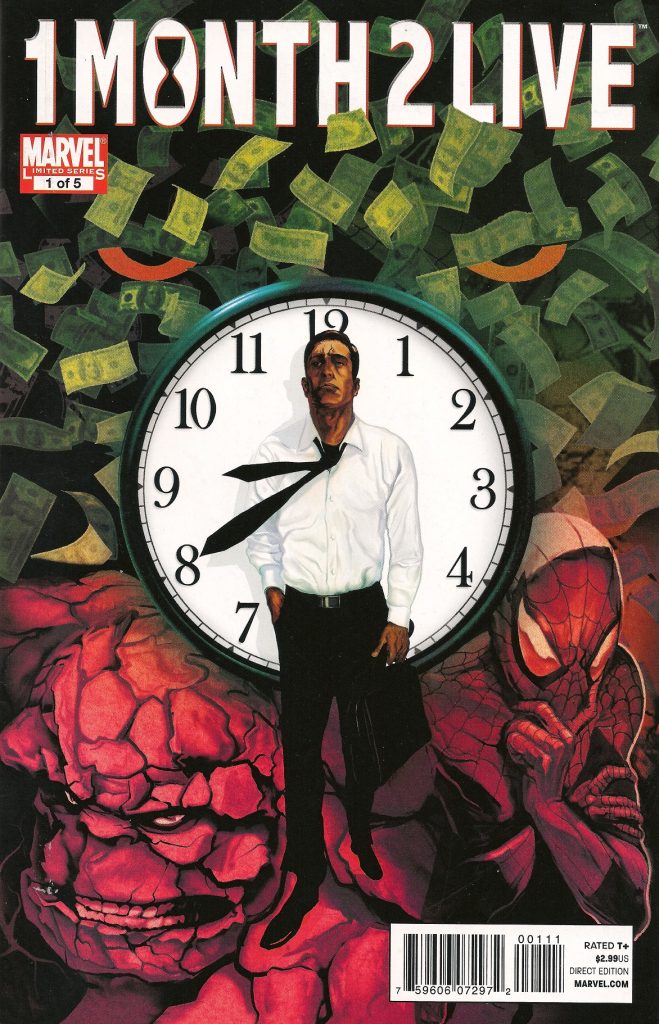
So much of writing for a living is solitary, so these occasional bouts of collaboration are (usually) really energising. Although, if you’re starting out it can be quite terrifying. I remember one of my first jobs for Marvel – a mini-series in 2009/2010 called One Month 2 Live. I’d be co-plotting with Rick Remender, Stuart Moore, John Ostrander, none of whom I’d ever met or spoken to. Steve Wacker, our editor at the time, put us on a conference call and told me I didn’t need to write a pitch beforehand (top tip – don’t be me, always have something slightly prepared when editors tell you this, just in case). We all join the call, I’m fairly nervous anyway, and then Steve says “Rob, why don’t you start us off and tell us your story.” I nearly had an out-of-body experience. I replied that I’d been told we’d be writing our pitches following this phonecall. Steve said (thankfully) that was fine and off we went. Call seemed to go well. I needed a lie down afterwards.
There’s always a moment of terror in pitching your ideas to a room, be it a real one or a conference call. DC flew me out to Los Angeles a few years ago and locked a bunch of us away in a room for a few days. You look up across the table and you’re pitching ideas to Geoff Johns, Scott Snyder, Jim Lee, Pete Tomasi, Brian Azzarello, Bryan Hitch. Take a breath, a sip from the hip-flask and trust that everyone there is buying into the team dynamic. And not judging your every utterance…. You can usually tell when something has legs. People start riffing with you. When you say “Hey, what if…” and no one really responds. Silence. Oop. Probably not then. But that happens to everyone.
I’ve co-written things so often over the years, you get used to the dynamic. As long as everyone’s giving and open and no one flips the table and shouts for attention, it’s usually a good experience and can bring a different energy to a project. OLD HAUNTS is coming from AWA next year. That’s a concept/script by me and Ollie Masters (The Kitchen). I co-wrote a season of DOCTOR WHO: THE ELEVENTH DOCTOR with Al Ewing (Hulk), and another season with Si Spurrier (Hellblazer). JUDGE DREDD: TRIFECTA was plotted out by me, Si and Al before we split the story up into Dredd, Simping Detective and Low Life chapters. In all those cases you break the plot between you, then you partition up the script so I get one issue, you get one issue etc. Then you’ll probably – but not always – hand your script to them to do a dialogue pass on your work, you’ll do a wee dialogue pass on theirs. That all creases out the joints, so you end up with a unified voice and tone.

Looking back on 2019 one of the exciting, unexpected projects was co-writing a screenplay with Geoff Barrow of the bands Portishead & Beak, movie scores etc (Ex Machina, Annihilation). That was slightly different as Geoff had a story and wanted to collaborate with a writer to script. It was a fun experience and we’ve ended up with something we both like a lot. More on that when there’s news to share, hopefully.
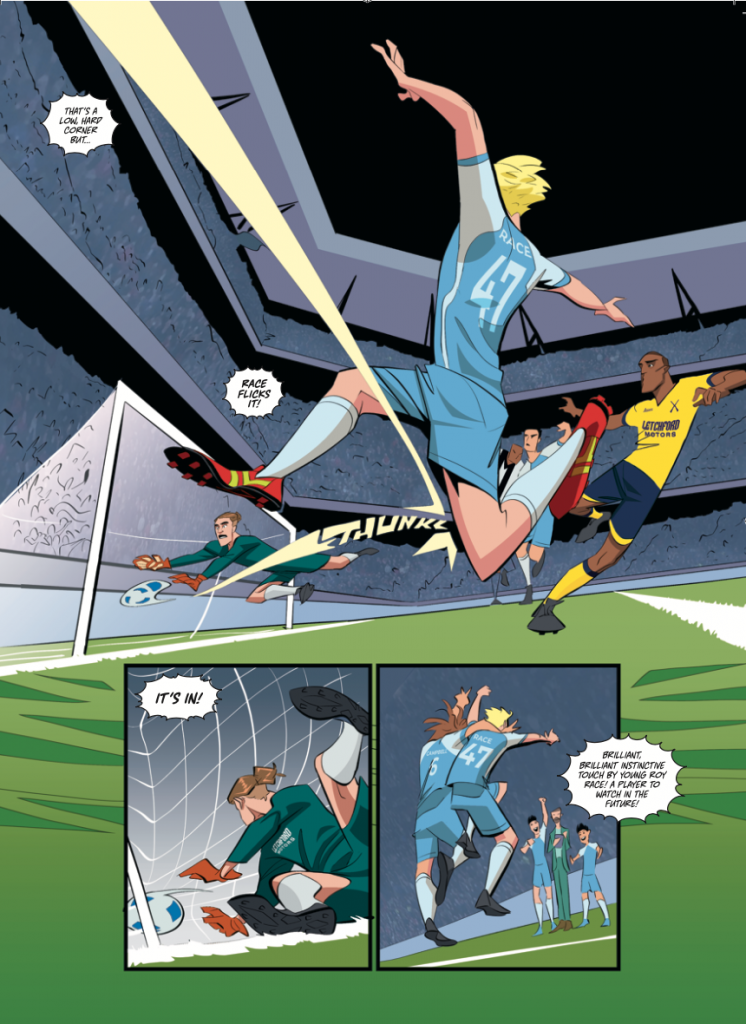
Anyway, back to Roy. Lisa’s art really brings a vibrant feel to Season Two. She’s terrific at character work and her storytelling really pops off the page.
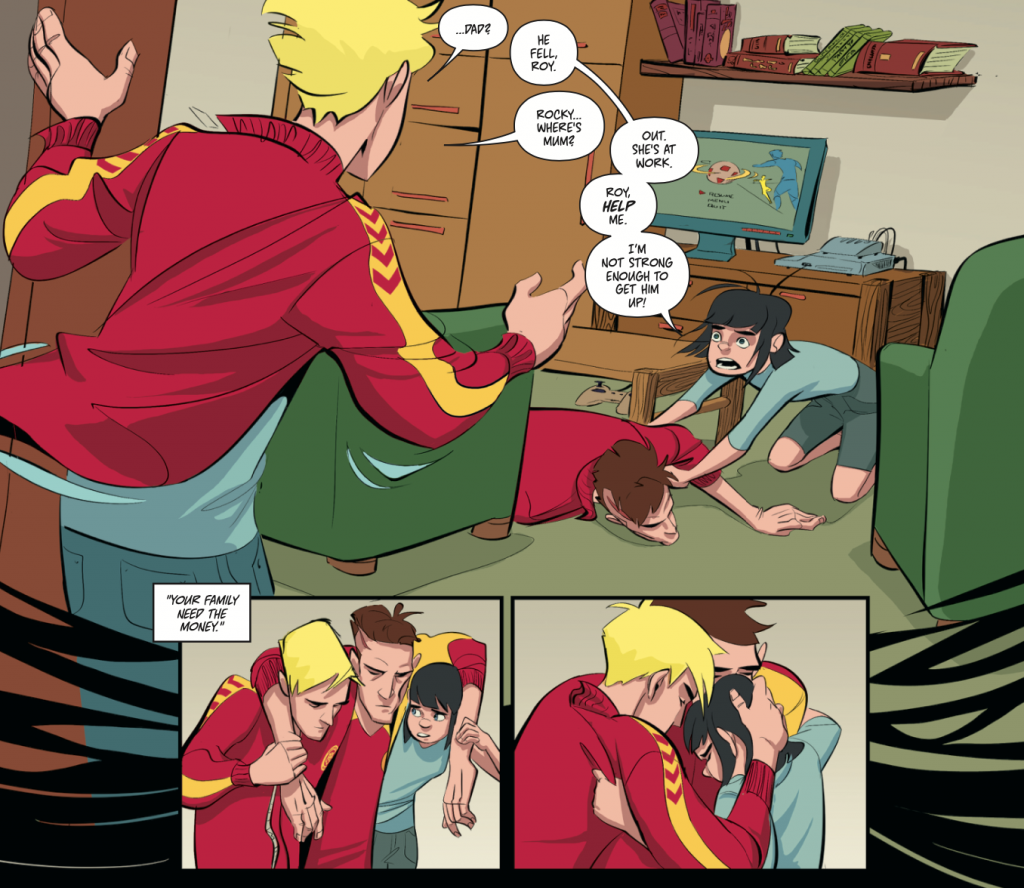
Roy’s tale is a soap opera. It always was back in his 70s/80s heyday. In this new version, we’ve tried to ground it a little more for contemporary themes. Back then it was ‘Who shot Roy Race?’ and the team being kidnapped by terrorists. In 2019/2020 Roy is a good kid, starting out on his footballing career, trying to help his family look after his dad, who is wheelchair-bound thanks to an illness. So you slip in themes like social care crisis, mental health is another we’re focussing on this season. All this taking place in a Melchester (Roy’s fictional home city) that is largely old terraced houses and embedded in some kind of ‘not that far removed from Manchester’ aesthetic.
But it’s a football tale – always. As we start Season 2 Melchester’s dodgy owner Barry ‘The Meat’ Cleaver has his eye on a quick cash grab, and that means making a quick sale on Roy Race and his pal Paco Diaz… to Rovers’ chief city rival, Tynecaster. Whether Roy likes it or not.
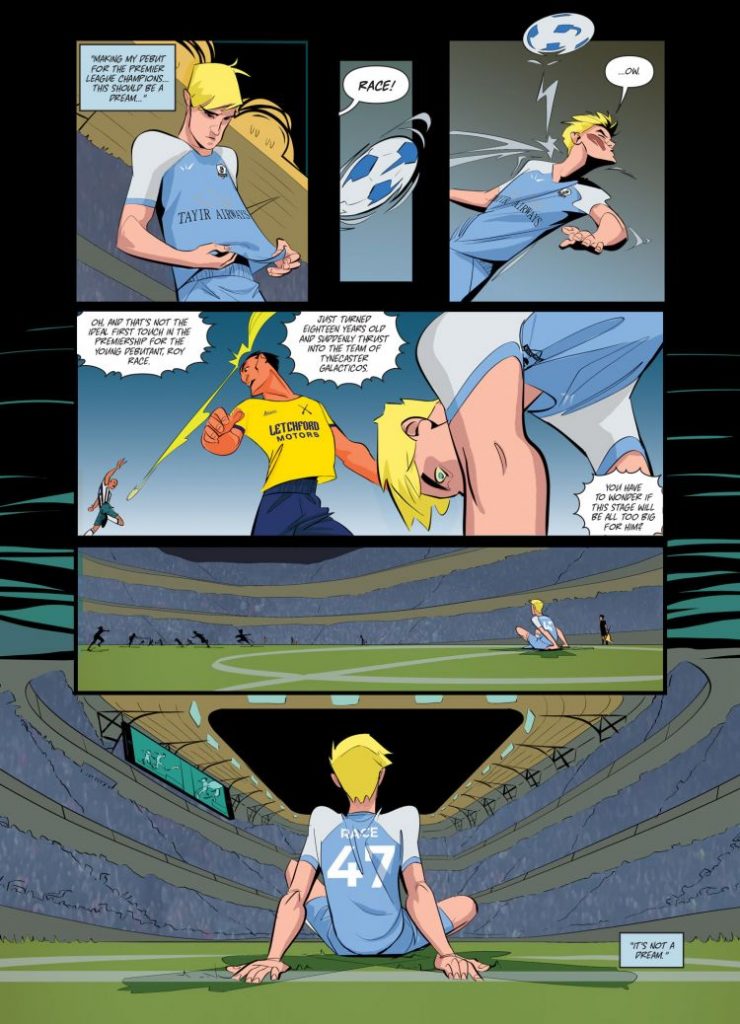
Roy of the… Tynecaster? It’s not right! But will it last?
Mind you, as an Arsenal fan, football, in general, is not right. At all.
Oh, JUDGE DREDD: CONTROL will be out next year. It’s a collection of all the Dredd stories by Chris Weston and me, including the total Judge Pin tale. Plus a few Dredds in there written by Chris. But it’s 100% Weston art, in all its highly-detailed glory.

You can preorder it here: https://www.amazon.co.uk/Judge-Dredd-Control-Rob-Williams/dp/1781087776/ref=sr_1_1?keywords=judge+dredd+control&qid=1575644248&sr=8-1
Merry Christmas!
 Follow

Fascinating stuff. I’ve never followed football but I loved Roy’s Seventies comic for the, as you mentioned, soap. It’s brilliant to see Roy back for a new generation. When I wound up working at Egmont Fleetway in the Nineties and Roy had the chopper accident, artist Barrie Tomlinson gave me the cover inset art for Roy’s ruined leg. Such fun!
Hi Martin. Yeah, Roy’s always been as much a soap opera as a football strip, I was totally gripped by “Who shot Roy Race?” as a kid. With the new books we’re trying to keep the themes grounded for 2020 teens to relate to. So, the Melchester lads are unlikely to be kidnapped by terrorists for a few seasons yet.